
|

|
FEATURED: Miracles of Mary: Apparitions, Legends, and Miraculous Works of the Blessed Virgin By Michael S. Durham; A beautiful art book filled with gorgeous color renderings of Mary, ancient and modern; also includes a delicious sampling of legends and beliefs about Our Lady from around the world, throughout the ages. |

|
FEATURED: The Secret Life of Bees By Sue Monk Kidd; This moving novel traces a young girl’s journey into womanhood. She escapes her abusive father by finding a strong community of women who honor Our Lady of Chains, a Black Madonna. Set in the South during the age of Civil Rights. |
See more
Recommended Reading
Introduction
God as Mother is the earliest known concept of the divine. The Great Mother was worshiped as early as 30,000 B.C.E., dating from The Earth Mother of Willendorf (A). Later she was known as Inanna in ancient Sumeria, Ishtar in Babylon, Anat in Canaan, Isis in Egypt and Aphrodite in Greece, and remarkably similar stories were devised to express her role in the spiritual lives of the people (B, p.5). When monotheism was on the rise, goddesses like Ashera, Ishtar or Anat . . . still had a great following among the Israelites, particularly among the women (B, p.50). This is evident in this Old Testament passage:
…we shall burn incense to the Queen of Heaven, and shall pour her
libations as we used to do, we, our fathers, our kings and our princes,
in the cities of Judah and in the streets of Jerusalem. For then we had
plenty of food, and we all were well and saw no evil. But since we ceased
burn incense to the Queen of Heaven and to pour libations, we have wanted
everything and have been consumed by sword and famine.
Jeremiah 44:15-19
Later, in The Coronation of the Virgin, Mary would come to share the title
Queen of Heaven with Inanna, Isis, and other goddesses who were worshiped before her. In the earliest recorded act of homage paid to Mary, she was honored with customary offerings to the Goddess. Women offered the Virgin cakes and wine at the shrine where their ancestors had worshiped the Goddess Ashtoreth. Epiphanius, the late fourth-century patriarch of Constantinople, noted with outrage that the women wishing to exalt the Ever-Blessed Virgin, have put her in the place of God. (A, p.194)
Similarly, when Christianity was brought to the British Isles, peasants saw in the story of Christ only a new version of their own ancient tales of the Mother Goddess and her Divine Child who is sacrificed and reborn, a tale which had held sway for 30,000 years (C, p. 18-19). In habits of devotion, especially those of women, there may have been no great discontinuity between the worship of the Virgin and that of the Goddess. Many shrines, statues and festivals, originally belonging to other Goddesses were rededicated to the Virgin (A, p.194).
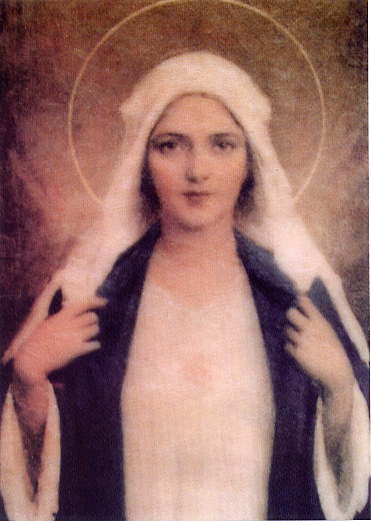
Throughout the ages, many leaders in Christianity have attempted to de-emphasize the role of Mary and (at times violently) suppress her worship, yet devotion to the Holy Mother has only increased. Apparitions and attendance at her pilgrimage centers are on the rise (A, p.206). Many Christians envision her as Co-Redemtrix. She has a dedicated following of millions, within and outside of the Catholic Church, around the world. Mary is a real, vital, dynamic force in the personal lives of everyday people. This website is dedicated to her.
Hail Mary, Full of Grace!
Blessed Art Thou Among Women!

© All original material in this site is under copyright protection and is the intellectual property of the author.
(A)
The Once and Future Goddess
By Elinor Gadon
(B)
A History of God.
by Karen Armstrong
(C)
The Spiral Dance.
by Starhawk
|
Comments? Suggestions? Contact Us |